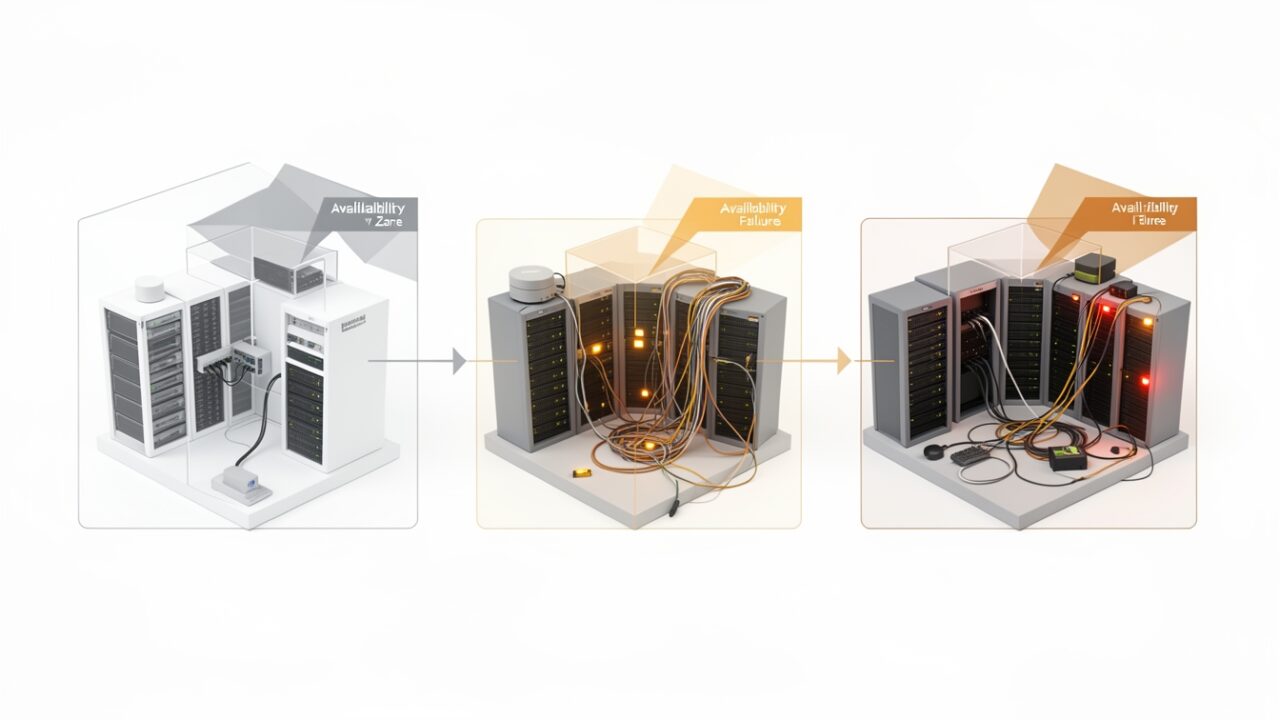
The failover didn’t fire. Zone went dark, traffic should have shifted, and instead half the requests hit a dependency that had quietly been pinned to a single zone eight months earlier during a “temporary” cost tidy-up nobody reverted. The architecture diagram still showed three zones, evenly balanced, exactly as designed. The diagram was correct. The system was not.
That gap — between the picture and the running thing — is the whole argument in Azure’s new perspective piece, Your Architecture Diagram Is Not Your Resilience. It’s not a product launch. It’s a posture correction, and an overdue one. Resilience, they argue, is not a property you design in once and check off at a Well-Architected review. It’s a property you maintain, or lose, continuously. If that sounds obvious, go look at when your last failover test actually ran.
3 zones, 1 unverified assumption
The canonical landing-zone move is to spread across three availability zones, draw the boxes, and call the workload resilient. Three is the magic number in most Azure regions that support zones — enough to survive one zone loss with quorum intact. The trouble isn’t the number. It’s that “deployed across three zones” is a statement about the day you deployed, and resilience is a claim about every day after.
Zone redundancy is only real if every hop in the request path is zone-redundant: the ingress, the compute, the data tier, the private endpoints, the dependency you didn’t build. Miss one — a zonal public IP where you meant zone-redundant, a storage account that quietly defaulted to LRS, a database whose zone-redundant setting got toggled off to save money in a non-prod clone that later got promoted — and the diagram lies to you. It still shows three boxes. The failover still won’t fire.
180 days is roughly how long a “resilient” system stays resilient
There’s no official half-life for resilience, so let me offer a field number: about six months. That’s the interval, in my experience, over which enough small changes accumulate that the original design assumptions no longer hold. Nobody makes a decision to become fragile. It happens by a thousand reasonable edits.
Azure’s piece names the mechanisms, and they match every post-incident review I’ve written:
- Configuration drift. The deployed state stops matching the IaC. A portal hotfix at 3 a.m., a manual scale rule, a policy exemption granted “just for the migration” and never revoked.
- Dependency version changes. The managed service you lean on ships a new default, deprecates an API version, or changes retry behaviour. Your resilience assumed the old one.
- Assumption rot. “The cache can be down for 30 seconds and we degrade gracefully” was true when someone tested it in 2024. Three features later, the cache is on the critical path and nobody re-checked.
- Team turnover. The person who knew why the health probe timeout was set to exactly 11 seconds left, and their replacement rounded it to 10 because it looked untidy.
None of these show up on a diagram. All of them show up in an incident.
0 new services — and that’s the honest part
Here’s what Azure is not doing: shipping a “Continuous Resilience” SKU with a sparkly icon. There’s no new product. The tooling they’re pointing at already exists, and the message is that you should be using it on a schedule rather than once.
The building blocks are the ones already in the platform. Azure Chaos Studio for fault injection. Azure Policy and initiatives for continuous configuration validation. Azure Monitor, alerts and workbooks for the observability that tells you an assumption broke. Deployment stacks and Bicep what-if for drift detection against your declared state. The Well-Architected reliability pillar and the Cloud Adoption Framework still stand — this is an evolution of that guidance toward validation, not a confession that landing zones were wrong. Landing zones give you a good starting configuration. They were never a promise that the configuration stays good.
1 scheduled experiment beats 100 architecture reviews
A review asks people whether the system is resilient. An experiment asks the system. The second one doesn’t lie to make you feel better.
The practice Azure is nudging toward is a recurring, low-blast-radius chaos experiment that asserts the failover you’re paying for actually works. Something you can wire into a pipeline and run monthly, in a controlled window, against a real environment:
Pair it with a continuous configuration check so drift gets caught by policy, not by an outage. You don’t need an exotic definition — the point is that the check runs forever, not once:
And catch drift against your source of truth before it becomes tribal knowledge:
If what-if comes back with a wall of changes you didn’t expect, that’s not a deployment problem. That’s a report on how far your reality has wandered from your intent.
7 things to audit before you trust the word “resilient”
If you inherited a system that’s labelled resilient and you want to know whether the label still means anything, here’s the short list I’d walk before signing my name to it:
- Storage redundancy. Confirm ZRS/GZRS where you assumed it. LRS is the silent default that eats zone claims.
- Zonal vs zone-redundant IPs and gateways. One word, entirely different failure behaviour.
- Data-tier failover. When did you last actually trigger it, not read the docs about it?
- Policy exemptions. List every one. Any exemption older than the incident it was created for is now a liability.
- Health probe and retry timeouts. Compare deployed values to the ones the design assumed. Someone “tidied” them.
- Managed identity and dependency auth paths. A token source that lives in one zone quietly makes your three-zone app a one-zone app.
- The runbook. Open it. Follow it line by line on a non-prod copy. Half of them reference resources that were renamed in 2024.
The uncomfortable part of Azure’s argument is that it moves resilience out of the design phase, where it’s cheap and pleasant to talk about, and into operations, where it costs on-call time and pipeline minutes and the occasional deliberately-broken Tuesday. That’s the actual bill. A diagram is a hypothesis. The only thing that makes it true is testing it on a schedule — before the zone does the test for you, at 2 a.m., without asking.