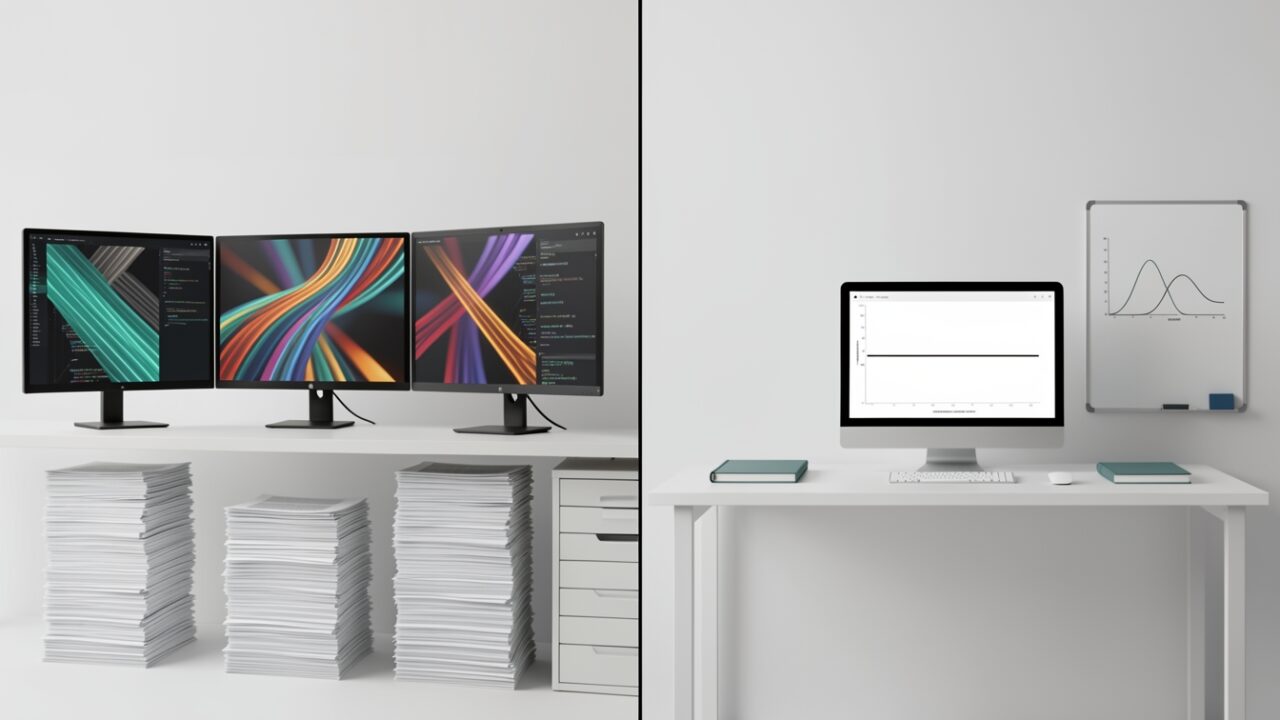
DeepMind engineer shares internal data: AI generates 75% of code but research shows no acceleration, undercutting fast-takeoff predictions.
Here is the number that should reset a few confident predictions: more than 75% of the production code at Google DeepMind is now written by AI. And the pace of AI research itself has not budged.
That second part comes from DeepMind’s Haydn Belfield, who has been sharing internal metrics publicly. His phrasing is blunt and worth quoting exactly: there is no measurable acceleration of AI research driven by AI. DeepMind tracks something it calls the General Capability Index, and on that index progress looks like a steady line. Not a hockey stick. Not a knee in the curve. A line.
If you have spent any time near the recursive self-improvement discourse, this should feel like cold water. The whole fast-takeoff story rests on a single assumed identity: AI that writes code can improve AI, which writes better code, which improves AI faster, and so on until the curve goes vertical. The 75% figure looks like the first step of exactly that loop. Except the loop isn’t closing. The code is getting written. The research is not getting faster.
The reason is the gap between generating code and advancing science, and it’s a real gap, not a measurement artifact. Writing code is a task with tight feedback: it compiles or it doesn’t, the test passes or it fails, the function returns the expected value. That is exactly the kind of problem current models handle well. Research is the opposite. The feedback is slow, noisy, and often absent. Knowing which experiment is worth running, reading a surprising result correctly instead of explaining it away, deciding a whole line of work is a dead end — none of that is bottlenecked on typing speed. A model that produces three-quarters of your diffs does not touch the part of the job that actually sets the pace.
The 88% number makes the same point from the other side. Belfield’s figures indicate that around 88% of AI-generated changes still go through human review and oversight. So the honest description of what’s happening at DeepMind is not “AI improves itself.” It’s “AI drafts, humans decide.” The humans are still the throttle, and the throttle is where the judgment lives. That ratio is the single most important thing in this story, and it’s the thing the autonomous-superintelligence crowd keeps rounding down to zero.
Let me be precise about what this is and isn’t. It is one engineer sharing one set of internal metrics at one lab at one moment. It is not Google policy, it is not a law of nature, and it is absolutely not proof that AI will never self-improve. Belfield is describing a snapshot, and snapshots move. The GCI line could kink upward next quarter and this whole piece ages badly. Fine. That’s the risk with any current data point.
But it is the first concrete internal data I’ve seen that directly contradicts the imminent-takeoff narrative, and that narrative has been doing an enormous amount of work in safety conversations. A lot of threat models — timelines, oversight budgets, the “we won’t see it coming” assumption — are implicitly priced on the curve bending soon. DeepMind’s own instrumentation says it hasn’t. If the lab most associated with the self-improvement story is measuring a straight line while AI writes most of its code, that’s not a footnote. That’s evidence the mechanism people fear isn’t automatically triggered by the milestone people pointed to.
And don’t lose the milestone in the skepticism. 75% of production code written by machines is a staggering adoption figure that would have sounded like hype two years ago. It’s just that the machines turned out to be excellent interns, not researchers.
The lesson isn’t that self-improvement is impossible. It’s that “AI writes the code” and “AI accelerates the research” are two different claims, and someone finally measured the distance between them. Right now it’s wide, and a human is standing in the middle of it 88% of the time.